

Swissocial Methodology
Swissocial methodology is fundamentally based on the study of the variations or changes that a project causes in its beneficiaries. Swissocial uses a matrix that considers tangible and intangible variables, individual and collective, allowing to combine the qualitative with the quantitative in a single tool. This provides a 360 degree analysis, which is comprehensive and robust.
In order to determine the impact on beneficiaries (and hence the effectiveness of a project) it is necessary to measure changes in the living conditions of beneficiaries, before and after the intervention by means of a valid instrument. The pre-project evaluation is called the "baseline". Successive measurements of the same beneficiaries, "ex-post evaluations", or simply "ex-post".
For economically active populations, Swissocial uses the methodology of the Social and Economic Welfare Index (SEWI).
This methodology is characterised by analysing all relevant aspects of the living conditions of an adult population. It uses a matrix comprising four main indicators (individual, collective, tangible and intangible). To calculate the value of these four main indicators, they evaluate nine variables (indicators) according to the following scheme:

In order to quantify each of the indicators, the SEWI uses a scale from 0 to 100. This allows the beneficiaries to be placed at a point on this scale in each of the evaluations (baseline and ex-post).
The SEWI contemplates 10 levels at which beneficiaries can be placed. These are as follows:
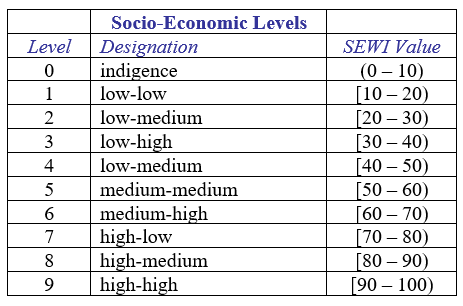
The comparison of the variation of the values of the indicators, through a study of prospective longitudinal cut, allows to establish the behavior of the beneficiaries.
The scales of the indicators are adapted to the socio-economic reality of the place where the beneficiaries live, in which “0” represents the absolute lack, and “100” the conditions of paradise on earth. In this way, the value obtained in the evaluations in each indicator refers to an absolute maximum (not in the place where the evaluation is carried out, but the maximum possible), and therefore allows a comparison both of the evolution of the beneficiaries, and of various projects among themselves.
By assessing beneficiaries before the start of the project (baseline) and at successive moments (ex-post), changes in these nine variables can be quantified, and thus the impact of the project on beneficiaries.
In order to attribute these variations to the project, it is necessary to have a control group, i.e. a population with characteristics similar to those of the beneficiaries, but which has not participated in the project. The difference in the variations in the values of the nine indicators between the beneficiary group and the control group measures the impact attributable to the project.
The data are taken by direct observation, especially through a questionnaire that evaluates all beneficiaries. For some less directly observable data, beneficiary assessments are compared with statistics from official international or non-governmental sources (e.g. for public security or the exercise of civil and human rights).